When most people hear the word cybersecurity, they immediately think of technical defenses: firewalls, encryption, antivirus software, or complex authentication systems. And yes, these are very important components of a secure digital environment. But the biggest breaches and incidents often don’t always start with hackers breaking complex code. They start with something far more simple and human: a hurried click on a phishing email, a password reused across multiple platforms, or a conversation overheard in the wrong place.
This raises an uncomfortable but crucial truth: in the digital era, people can be either the weakest link or the strongest defense in the cybersecurity chain.
What do we mean by “The Human Factor”?
The human factor in cybersecurity refers to the role that people such as employees, managers, and even customers play in protecting or exposing an organization’s digital assets. While firewalls and encryption can block many technical attacks, it only takes one distracted moment for someone to click a malicious link, share credentials, or be manipulated by a convincing phone call.
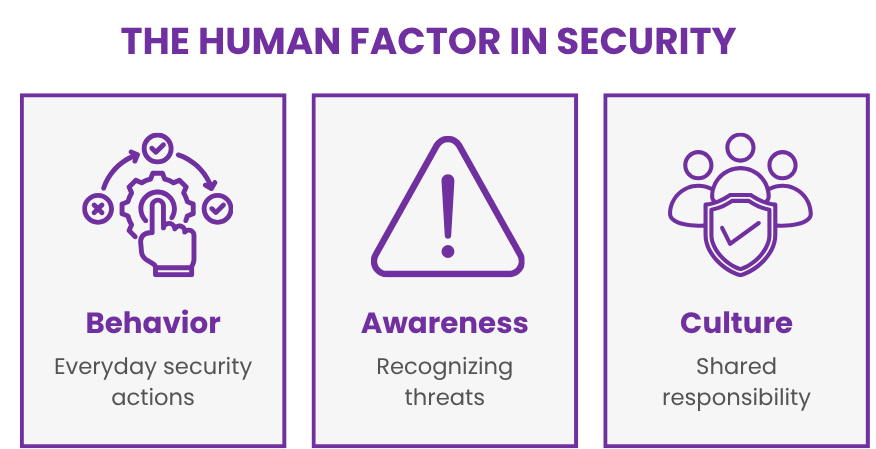
At its core, the human factor is about behavior, awareness, and culture:
- Behavior: The everyday choices employees make, from creating strong passwords to locking screens when they leave their desks.
- Awareness: The ability to recognize threats like phishing attempts, social engineering, or suspicious activity.
- Culture: The shared values and attitudes toward security within an organization whether employees feel responsible and empowered to protect sensitive data or see security as “someone else’s job.”
The impact of these human decisions cannot be underestimated. According to the World Economic Forum, 95% of cybersecurity incidents occur due to human error. This is a reminder that even the simplest slip-ups, avoidable through proper awareness and training, can open the door to disaster.
The growing Threat Landscape
Cyberattacks are no longer rare, isolated incidents. They’ve become a daily reality, affecting organizations of every size and sector. Ransomware, phishing campaigns, and social engineering tactics are evolving faster than ever, often exploiting human behavior rather than technical loopholes.
- Phishing remains the #1 attack vector: Employees receive emails that appear to come from trusted colleagues, clients, or even CEOs, asking them to click a link or transfer funds.
- Social engineering is on the rise: Attackers use psychology urgency, fear, or curiosity to manipulate people into making costly mistakes.
- Hybrid work adds complexity: With employees splitting time between office and home, unsecured networks, personal devices, and distractions create new entry points for cybercriminals.
Case in point: When one password ends a company
A recent ransomware incident showed just how devastating a single human error can be. One password is believed to have been all it took for attackers to break into the systems of a transport company. Once inside, they encrypted data and locked internal systems, a blow so severe that the business was destroyed, leaving 700 people out of work. The company’s director admitted he hasn’t even told the employee whose password was likely guessed, asking: “Would you want to know if it was you?”
People as the first line of defense
While employees can be targeted, they also have the potential to be your organization’s most powerful protectors. The difference lies in awareness, culture, and support.
- Awareness training that sticks
Traditional one-off cybersecurity trainings are often too technical or abstract to be effective. Instead, interactive simulations like phishing tests, gamified scenarios, or workshops help employees experience the risks in a safe environment. This builds confidence and long-term vigilance. - Encouraging a speak-up culture
Too often, employees fear punishment if they make a mistake. But silence only makes breaches worse. By promoting a culture where staff feel safe reporting suspicious activity or admitting errors, organizations can respond faster and limit damage. - Everyday security habits
Simple behaviors like using password managers, enabling multifactor authentication, locking laptops when away from desks can stop a surprising number of attacks. Building these habits requires consistent reinforcement, not just policy documents.
Leadership sets the tone
Cybersecurity culture doesn’t develop in isolation. Leaders play a crucial role in shaping how seriously teams take security. When executives model good practices (like following MFA protocols themselves instead of seeking exceptions), it signals that security is a shared responsibility.
Moreover, leaders who frame cybersecurity as an enabler of trust, rather than as red tape, help employees see the bigger picture. Customers, partners, and stakeholders all want to know that organizations can be trusted with sensitive data.
A practical path forward
Organizations that want to turn the human factor from liability to strength can start small:
- Run regular, realistic phishing simulations and provide immediate feedback.
- Celebrate positive security behavior, such as reporting suspicious emails or updating passwords.
- Make policies human-friendly by writing them in clear, simple language instead of technical jargon.
- Integrate security into daily workflows, so it becomes second nature rather than an afterthought.
By focusing on the human factor, organizations don’t just prevent incidents — they build lasting resilience.
Conclusion: turning awareness into action
Cybersecurity is no longer just about technology, it’s about people. When employees understand the risks and are empowered with the right habits, they shift from being a potential weak link to becoming your strongest defense. Building a culture of security is the key to long-term resilience.
Learn more practical strategies in Hacked, Now What? by Nathalie Claes, CEO of Dadir.